
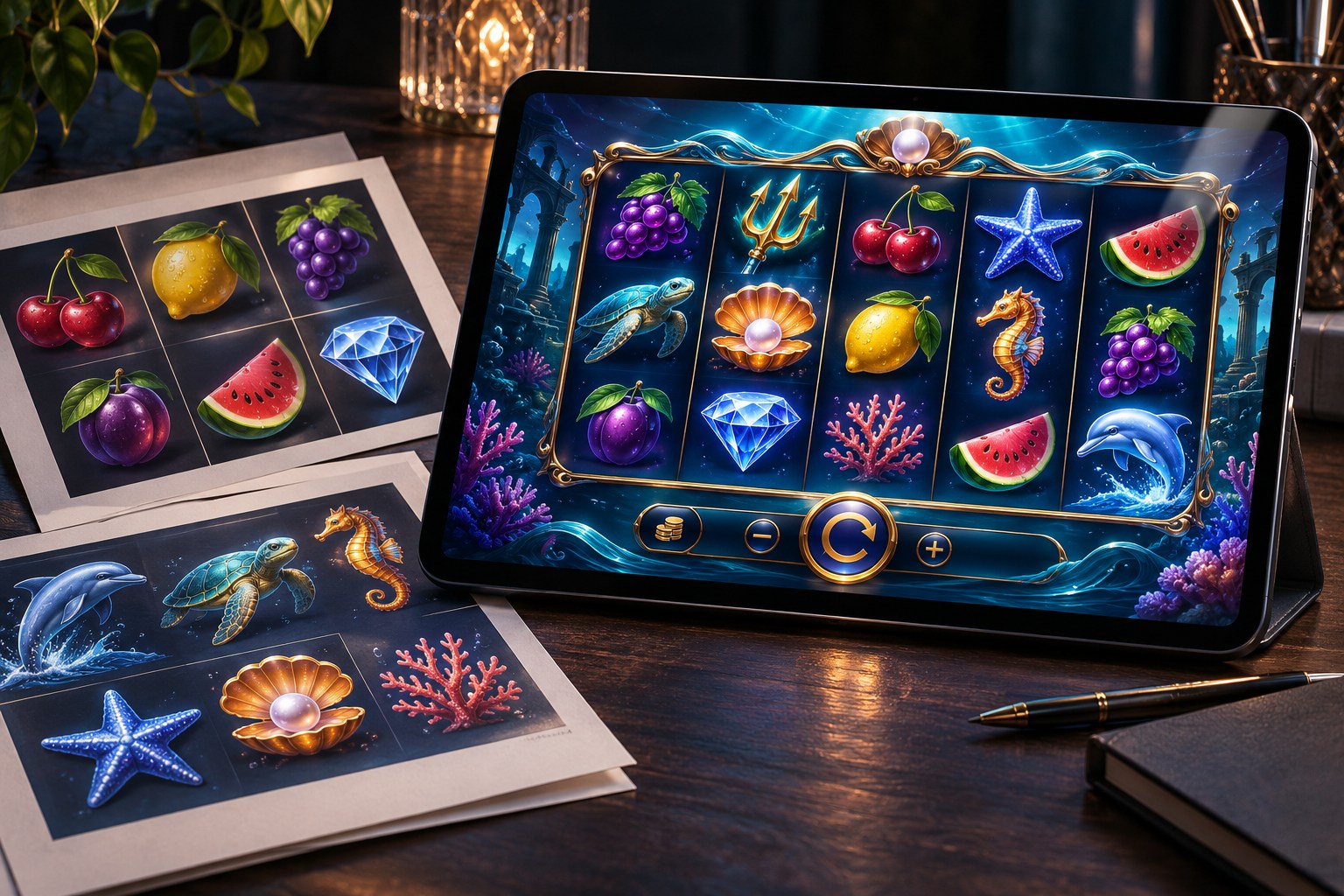
Slot design turns a mathematical outcome into a readable experience. The reel layout, symbols, animations, audio and controls must describe the same result. A striking theme cannot fix an unreadable paytable or a bonus sequence that contradicts the rules.
For studios building slots for New Zealand, the brief also has to accommodate the Online Casino Gambling Act 2026 and related minimum standards. Round timing, deliberate input, accessible rules and harm-minimisation controls affect the interface long before the first asset is exported.
What Does Slot Design Actually Cover?
Three systems have to agree: game maths determines results, the presentation layer shows them, and the platform records and settles each round. Slot graphic design handles only part of that chain. A polished reel screen cannot compensate for an undefined state or a missing transaction.
| Design layer | Main decisions | Proof that it works |
|---|---|---|
| Game concept | Audience, theme, core mechanic, reel format and feature pacing | A consistent game design document (GDD) |
| Game maths | RTP, volatility, hit frequency, symbol weighting, paytable and maximum win | PAR sheet and simulation results |
| Art and audio | Symbols, backgrounds, characters, UI, VFX, animations and sound cues | Readable assets mapped to defined game events |
| Interaction design | Bet controls, spin states, information hierarchy and accessibility | Mobile usability tests and state-by-state checks |
| Engineering | HTML5 client, RNG, remote game server, wallet events and recovery | Integration tests, audit trails and lab documentation |
An expanding-wild animation has no place in a game whose maths never permits that event. Building the sequence anyway wastes art and engineering time; fixing it late adds regression tests. Settle such behaviour in the game design document (GDD).
Start With the Game Concept, Not the Symbol Artwork
A concept might centre on fruit symbols, free spins in a character-led video slot, or cascades and multipliers. Theme and mechanics should reinforce each other. Decorative language is no replacement for clear betting rules.
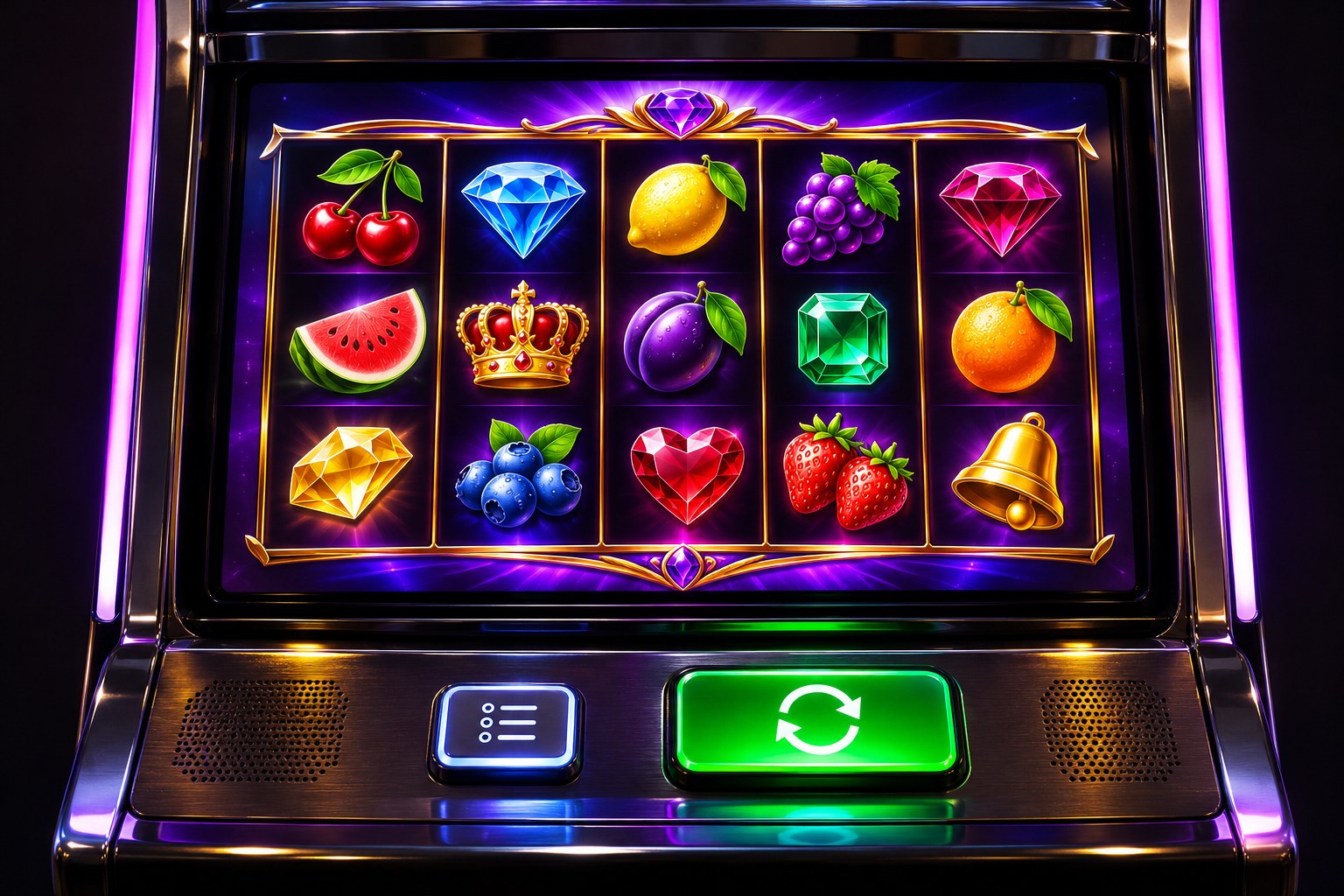
The brief sets the audience, platform, base game, bonus game and complexity. A 3-reel classic needs instantly recognisable symbols and a compact paytable. A 5×3 video slot has space for paylines, wilds and scatter-triggered free spins; a 6×5 cluster-pays grid calls for different spacing and win highlighting. One layout will not fit all three.
Mechanics determine how much must be drawn, animated and tested. Fixed reels with line wins need fewer states than expanding reels, hold-and-win respins or a multi-stage bonus. Choose the primary mechanic before adding secondary features.
Original Slot, Reskin or Art-Only Production-
An original slot needs its own concept, maths, rules and assets. A reskin changes the artwork and audio while retaining the approved mechanical foundation, subject to the relevant approvals and change controls. In art-only production , a studio delivers symbols, backgrounds, interface art and animations to a developer that already owns the engine and maths.
A character change or new soundtrack need not touch reel strips. A revised multiplier, paytable or feature probability does. Scope costs, timelines and any certification work separately for cosmetic and mathematical changes.
Slot Mathematics: The Rules Behind the Experience
The maths model defines the theoretical distribution of outcomes; artwork communicates what it has selected. The spin animation cannot alter that result or imply that visual timing gives the player control. One specification should cover every payable state.
| Term | Meaning in slot design | Design consequence |
|---|---|---|
| Return to Player (RTP) | The theoretical percentage of stakes returned across a very large number of plays | Must match the configured game and its disclosed information |
| Volatility | How widely outcomes vary around the expected return | Shapes the mix of smaller wins, dry periods and larger prizes |
| Hit frequency | The proportion of rounds that produce a defined winning outcome | Influences how often win feedback is displayed |
| Bonus frequency | The probability of triggering a feature | Sets realistic expectations for feature pacing and asset usage |
| Maximum win | The upper payout limit, often expressed as a multiple of stake | Sets the ceiling for payout events and prize presentation |
With an illustrative 96% RTP, the theoretical model returns NZ$96 for each NZ$100 staked over its full outcome distribution. A person staking NZ$100 is not promised NZ$96 back. Volatility, hit frequency and bonus contributions can differ even when two games share the same RTP.
A PAR sheet captures reel strips or weighted symbols, paytable entries, paylines or ways to win, feature probabilities and each component's return contribution. Monte Carlo simulations compare the built game with those calculations. Edge cases need their own tests: maximum-win combinations, retriggers and unusual bonus sequences.
The random number generator (RNG) supplies the random input for a result. Reel-stop animation reveals the outcome already chosen; it does not choose it. Server-side outcome handling, cryptographic RNG controls and transaction records keep device behaviour and network delays separate from game decisions.
Keep Reels, Symbols and Features Consistent
Each reel system needs its own visual explanation. Paylines follow defined paths; ways to win check matching symbols on adjacent reels without fixed lines. Cluster pays count connected groups, while scatter pays use separate rules. Cascading reels replace removed winning symbols; expanding reels alter the grid itself.
A wild substitutes for eligible symbols as the paytable permits; a scatter often triggers a feature without a payline. Bonus symbols, mystery symbols and multipliers have distinct rules. Sticky wilds persist for a set period. Hold-and-spin and hold-and-win lock qualifying symbols during respins, while free spins may change reel strips, multipliers or retrigger conditions.
The screen has to account for those states. During hold-and-win, locked positions and remaining respins must stay visible. A cascade needs a readable order: highlight the win, remove symbols, refill the grid. Variable-height reels squeeze symbols into smaller cells. Jackpot interfaces must distinguish fixed prizes, local progressive pools and network progressive jackpots, with eligibility rules close at hand.
Megaways is a named commercial mechanic associated with licensed implementations. It should not be used as a catch-all label for variable-reel games. Check rights before adopting proprietary names or features.
Slot Game Art: Design for Recognition Before Detail
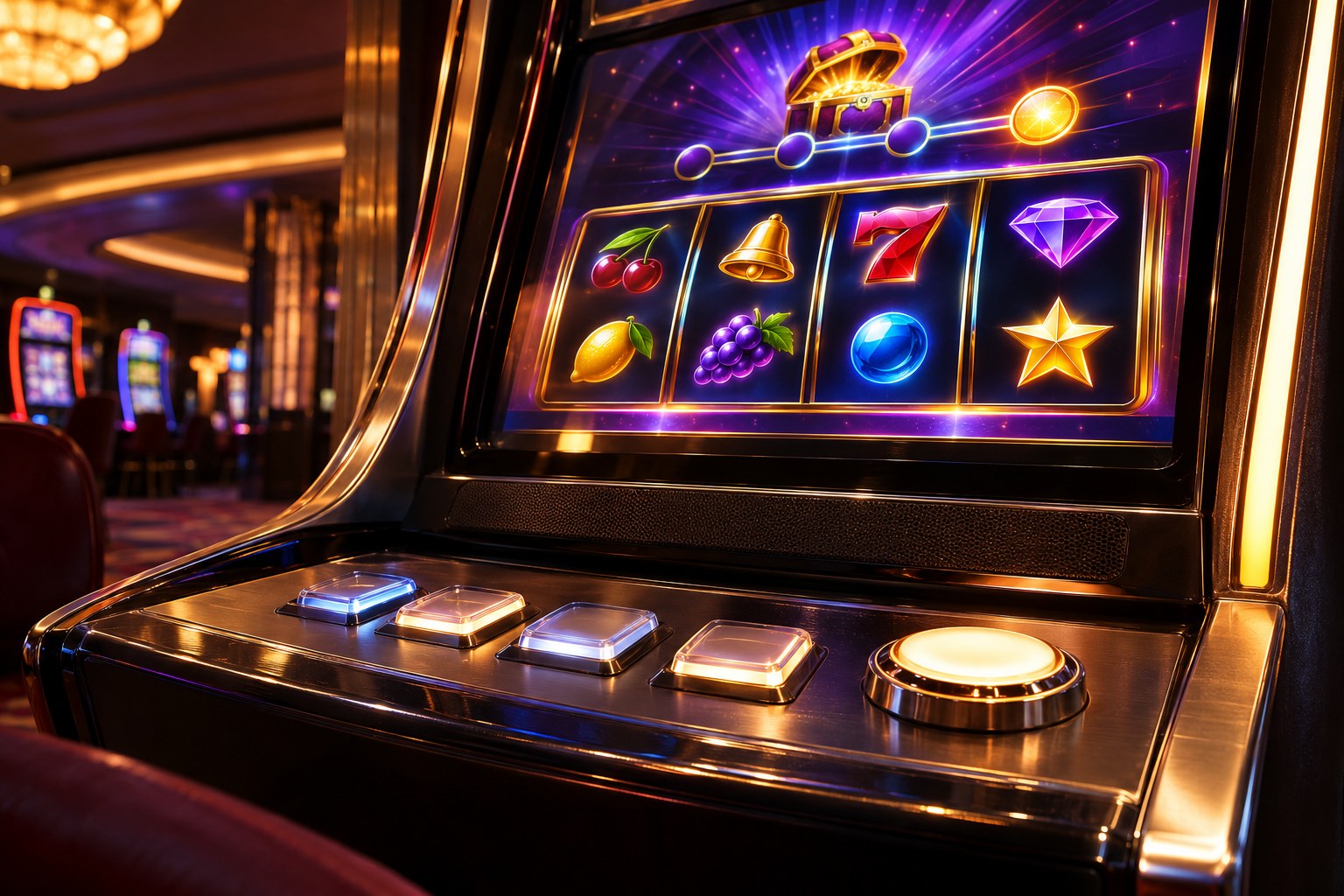
Art direction starts with a moodboard, palette, type choices, lighting and perspective. The production inventory covers the reel frame, low- and high-value symbols, wilds, scatters, backgrounds, bonus screens, win overlays, buttons and lobby thumbnails. Character treatment must remain consistent across them.
A Hierarchy That Survives a Small Screen
Low-value symbols often use card ranks or simple themed objects. Their silhouettes and framing need to remain clear. Premium symbols can carry richer textures; wilds and scatters must still look different without colour or motion.
A full-resolution concept painting tells little about readability on a phone. Test illustrated, 3D or hybrid 2D/3D assets inside the smallest supported reel cell. Fine lettering, near-identical silhouettes and detailed scenery can disappear when reels move.
Every Feature Creates More Asset States
Each event needs the correct asset state: normal, highlighted, winning or feature-specific. Bonus intros, win counters, character reactions, transitions and particles should fire only when the game sends the matching event. The style article needs rules for wins, triggers, locked symbols and disabled controls.
Audio follows the same event map. Reel stops, wins, feature triggers and settlement require distinguishable cues, alongside mute and volume settings. Sound effects (SFX) and music must not dress up a return smaller than the stake as a large profit.
Mobile-First Slot UI/UX: Clarity Over Visual Noise
Balance, stake, win amount and the next permitted action must remain visible without crowding the reels. Even a large spin button cannot obscure the cost of another round.
Portrait and landscape layouts require separate composition decisions. Portrait often puts reels above thumb-reachable controls. Landscape offers width but cuts space for text. Notches, rounded corners and system gestures create safe-area constraints. Scaling down a desktop image misses these problems.
Use unambiguous amounts and currency labels, including NZD when the game operates in New Zealand dollars. Balance, current win and net position are different numbers. The interface must not blur them into one animated figure. Rules, paytable, RTP, settings and session tools also need dependable navigation.
Contrast, readable type, distinct icon shapes, visible keyboard focus and adequately spaced touch targets all matter. WCAG 2.2 provides reference criteria for contrast and target size, though legal requirements still need a jurisdiction-specific check. Never make an instruction depend only on colour, sound or motion.
A static idle screen hides problems. Inspect the layout during a pending spin, a settled win, an open paytable, a bonus transition, a lost connection and a resumed round.
Animation and Timing Are Product Rules
Motion should tell the player what changed: reel stops, highlighted wins, expanding wilds, cascades and feature transitions. Particle effects and camera moves belong behind the outcome, not over the stake or settlement figures.
Spine 2D rigs, sprite sheets and skeletal animation offer different ways to package motion. Engine compatibility, file size and device performance decide which fits. An event map must state what starts each animation, when controls are disabled and when the round settles.
Do not celebrate a payout below stake as though it were a net gain. Audio, timing and wording must distinguish a return of funds from profit.
Production Handoff: From Design Files to HTML5 Slots
An integration-ready art handoff includes file names, dimensions, export settings and source ownership. Typical deliverables are layered PSD or vector files, transparent PNG or WebP assets, texture atlases, sprite sheets, animation data, UI annotations and a colour/type specification. Spine rigs and 3D scenes may also require editable source projects.
An HTML5 client may use PixiJS, Phaser, Cocos Creator or Unity; the rendering needs and existing stack determine the choice. Compressed assets, texture atlases, progressive loading and resolution variants keep mobile downloads and memory use under control.
The remote game server (RGS) and casino platform must reconcile launch records, bet debits, win credits, round history, interruptions and rollbacks. Shared identifiers matter when a wallet request is repeated after a network failure. Aggregators broaden distribution, but each operator integration still needs configuration checks.
Before handoff, name the owners of the GDD, PAR sheet, source art, code, RNG connection, localisation strings, test records and maintenance. Those responsibilities change between an art-only commission, a licensed engine and an exclusive operator title.
Designing for New Zealand's Online Casino Rules
New Zealand's Online Casino Gambling Act 2026 took effect on 1 May 2026 and introduced licensing in stages. The Department of Internal Affairs expects the full licensed regime to operate in 2027. The Online Casino Gambling (Minimum Standards) 2026 , in force from 8 July 2026, establish technical requirements for operators within their scope. Teams need to verify which obligations apply to the operator during the transition.
For slot interfaces, the standards cover:
- Round timing: at least 2.5 seconds must pass from the start of a round before the next round can begin.
- Deliberate input: every new round requires a separate conscious action; holding a button or automatic repeat-play must not start another round.
- Single-slot play: the platform must not combine slot games to facilitate simultaneous play of more than one slot.
- Visible information: players need access to game rules, odds, theoretical RTP and a clear display of their net position since the game began.
- Time awareness: a means of tracking time must remain available, including an in-app clock or elapsed-time display if full-screen play conceals the device clock.
- Player controls: time, deposit and spend limits, breaks in play, time-outs, alerts and self-exclusion require accessible and enforceable platform functions.
Under-18 age checks, New Zealand location controls and account security sit in the surrounding platform. RNG rules require demonstrably random outcomes and ban adaptive or compensated behaviour. Automatic repeat-spins, hidden RTP details and unclear net results present compliance problems, not just visual ones.
Experience with GLI-19, UKGC or MGA testing is not New Zealand approval. International standards may inform the evidence package, but the local rules and the operator's licence conditions still govern.
QA and Certification Begin Before the Final Build
QA must test the shipped game against its maths, not just against art mock-ups. Cover paylines, ways-to-win calculations, wild substitutions, scatter triggers, free-spin retriggers, multipliers, maximum-win caps, jackpots, bet limits and edge states.
Laboratory submissions typically bring together rules, reel and symbol data, paytables, RNG evidence, simulations, version records and testable client/server builds. Accepted laboratories and certification scope vary by jurisdiction. Changes to the maths or features need formal control; cosmetic reskins still need regression and accessibility checks.
On lower-powered phones and poor connections, measure load time, memory, frame stability, touch response and recovery. Replayed requests must not charge a stake twice. Interrupted rounds must settle or resume correctly, with identical results in the wallet and history.
How to Scope a Slot Design Project
A reskin on an existing engine costs differently from a new mechanic with bespoke maths, server integration, progressive jackpots and two screen orientations. Count original assets and distinct game states, not just reels.
A meaningful quote names the GDD and maths owners, asset inventory, devices, source-file handoff, RGS and wallet interfaces, jurisdiction, review rounds, testing costs, IP rights and maintenance. Without these boundaries, two similarly priced offers may cover very different work.
Symbol art can progress alongside client development, with audio following approved animations. Maths and compliance decisions need earlier agreement. A late mechanic change triggers new art, code and tests; launch timing also depends on integration and lab availability.
Common Slot Design Failures and Their Fixes
- Beautiful symbols that merge on mobile: test silhouettes and contrast in a live reel at the smallest supported size before detailing the artwork.
- Bonus features without a maths budget: define trigger odds, feature contribution and retrigger rules before animating the sequence.
- Confusing money displays: separate balance, stake, win and net position and verify each against wallet events.
- Decorative motion that obscures facts: prioritise settled outcomes, readable controls and a clear distinction between stake returned and profit.
- Desktop assets forced into portrait mode: design orientation-specific layouts, safe areas and responsive asset variants.
- Incomplete handover: require editable sources, export bundles, state diagrams, naming standards, implementation notes and rights documentation.
- Compliance left until launch: include local round timing, deliberate-action rules, session controls and RNG evidence in the initial acceptance criteria.
Slot Design FAQs
Slot Design vs Game Development
Design specifies the rules, visual language, controls and player feedback. Development builds them into client and server software, connects RNG and wallet services, and prepares a testable release. The teams overlap when they map states and implement features.
Can the same slot maths be used with different artwork?
Yes. A reskin can retain approved slot maths while replacing symbols, backgrounds and sound. Each symbol must still communicate the same function. New paylines, reel behaviour, paytable values or feature probabilities require a maths change.
Does a higher RTP mean a slot pays more often?
No. RTP describes long-run theoretical return; hit frequency counts how often a defined winning event occurs, and volatility describes how widely results vary. None forecasts the next spin or a player's session return.