
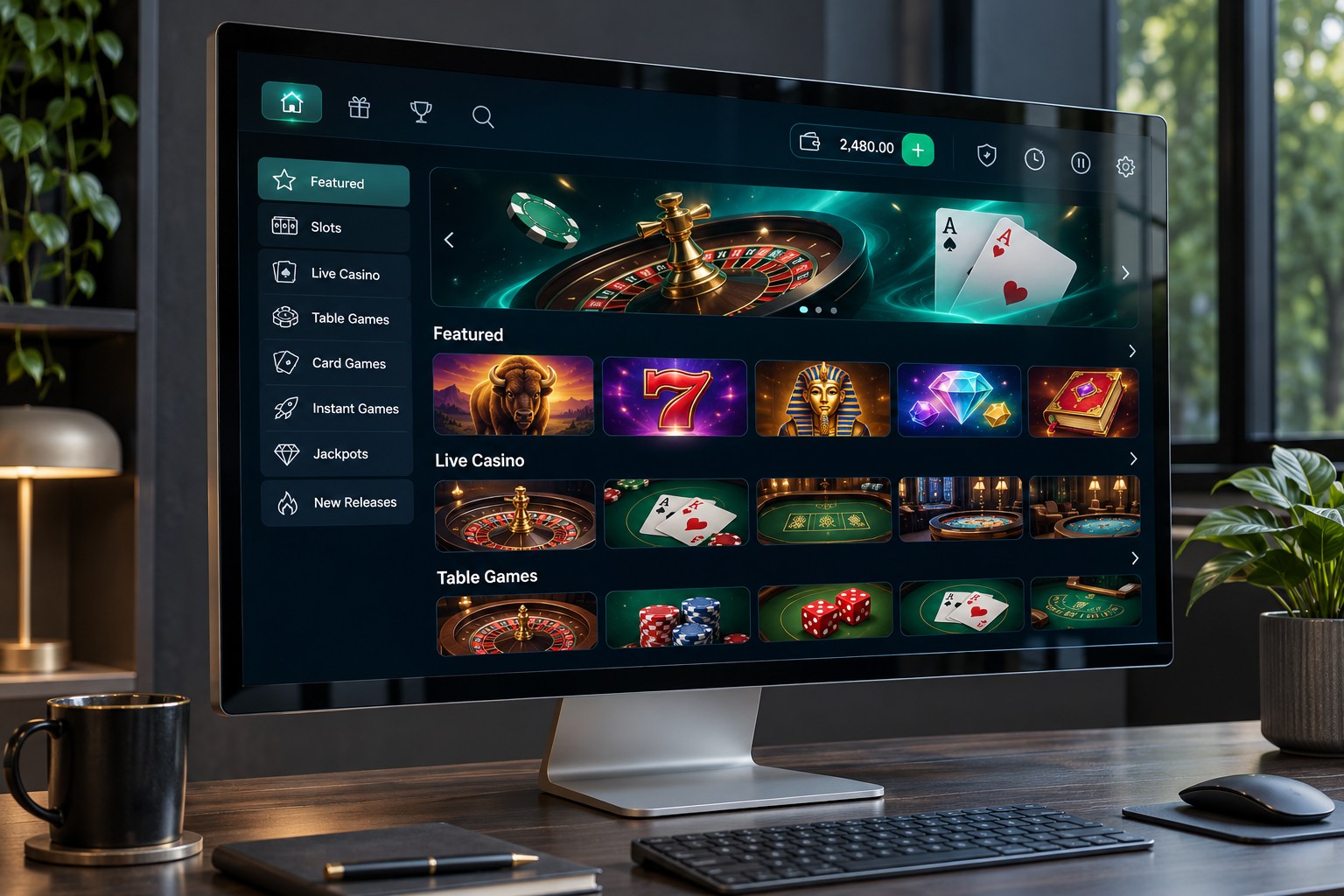
An online casino interface connects the lobby, game controls, player account, cashier, identity checks and safer-gambling tools. Players need to know where to go, what a stake means, whether a payment worked and how to stop play.
For New Zealand-facing operators, that ordinary journey has legal constraints. A polished lobby is worthless if a player cannot find a spending limit, understand a withdrawal delay or close an account. Those tasks deserve the same design attention as game discovery.
What makes up an online casino interface?
UI covers buttons, forms, filters, typography, colour and game tiles. UX concerns whether people can use them. A coherent visual style is no help when someone cannot find blackjack or confirm that an identity-document upload succeeded.
Two frontends need to work together. The platform interface handles game discovery, sign-up, wallet, support and account controls. The game interface handles reels or tables, stakes, results, paytables and rules. Behind both sit payment systems, game aggregation, compliance services and the casino platform. A screen cannot offer an action that its backend cannot fulfil.
| Interface surface | Player's immediate question | Essential design response |
|---|---|---|
| Casino lobby | Where is the game I want? | Recognisable categories, search, filters and clear game cards. |
| Game screen | What am I staking and what happened? | Readable stake, balance, outcome, rules and game information. |
| Registration and KYC | Why is this information required? | Explicit steps, field guidance, verification status and recovery paths. |
| Cashier and wallet | Where is my money? | Payment eligibility, fees, status, withdrawal conditions and history. |
| Player account | How do I manage my activity? | Transactions, security, limits, breaks, self-exclusion and support. |
On a withdrawal screen, a bonus takeover gets in the way.

Casino Lobby Design for Clear Game Choice
A game gets lost in a lobby of hundreds of similar tiles. Start with recognisable categories: Slots, Live Casino, Table Games, Blackjack, Roulette, New Games and Jackpots . Avoid relabelling the same catalogue with multiple promotional names.
Search, filtering and game discovery
Known-title searches and browsing require different tools. Search should handle partial names, misspellings, autocomplete and game-provider names. Filters can narrow results by provider, theme, game feature, betting range and reliable volatility data. Call a live-table filter “Live Dealer”, not a code imported from a supplier feed.
A game tile needs recognisable artwork, a readable name and a clear action. Reserve a consistent image size. “New”, “live” and “progressive jackpot” are useful when accurate; stacking “hot”, “exclusive” and “recommended” is not. For live blackjack or roulette, prioritise table availability, betting limits and round status.
Recently Played and Favourites help players return to known games. Recommendations should be dismissible and secondary to explicit search. They should never displace account limits or transaction history.
Use promotions without hiding the catalogue
Hero banners can highlight a new title; auto-rotating carousels can crowd out the catalogue, especially on phones. If the navigation includes bonuses, loyalty tiers or tournaments, show eligibility, expiry, wagering conditions and restrictions. The promotional tile alone is not an explanation of the offer.
Game Atmosphere and Informed Play
Slots and live roulette have different mechanics but the same basic disclosure needs: stake, balance, result and rules. Opening a preview or paytable must not start a round.
Explain mechanics at the point of use
Return to player (RTP) is a theoretical long-run percentage, not a forecast for one session. Volatility concerns how widely returns vary. Paylines, features and jackpots need their own explanations near the game information panel. A random number generator (RNG) determines outcomes in relevant games; a “fair play” graphic by itself verifies nothing.
Do not celebrate a return smaller than the stake as a net win. Result labels, sounds, animations and balance movements should agree. For live dealer games, show table limits and the round and stream states. If the stream drops, explain whether the bet was accepted and where to verify its outcome.
Never optimise away a deliberate decision
Speed is no excuse for obscured stakes or a rushed next round. Give the player a deliberate start action, a stable result state and a visible session clock. Automatic repeat play is not a harmless shortcut.
Registration, Verification and Payments Are Part of UX
A lobby can work perfectly while identity verification fails. Registration, know-your-customer (KYC) checks and the cashier belong in the same product journey, even when vendors operate parts of it.
Make onboarding and KYC predictable
Keep field labels visible and errors specific. Explain requests for date of birth, address and identity documents beside the relevant field. “Documents received; review pending” is useful; a spinner is not. A failed upload, expired session or lost connection needs a recovery route that preserves valid progress.
Age checks and location checks enforce access requirements. Account security needs clear routes too: password reset, multi-factor authentication (MFA) , suspicious-login warnings and sign-in after an inactive session.
Treat withdrawals as seriously as deposits
In the cashier, distinguish available balance , deposits , pending withdrawals and completed transactions . A player should see eligible methods, any known fees and checks still required before making a request. “Submitted”, “Under review”, “Processing”, “Paid” and “Failed” describe different states; one indefinite “Pending” does not. Do not promise a payout time that a payment service provider cannot control.
Use NZD for balances and examples when the product actually transacts in New Zealand dollars. If another currency is involved, identify it and disclose conversion information before confirmation. The payment logos shown on an overseas casino cannot simply be carried into a New Zealand-regulated cashier: local payment restrictions determine what can be offered.
A transaction entry needs its amount, date, reference, status and a route to support or complaints. Failed deposits, rejected payment methods and delayed withdrawals need explanations, not indefinite loading screens.
Mobile Casino UX with Essential Details in View
Mobile-first design starts by deciding what stays visible on a narrow screen. A scaled-down desktop lobby is not enough. Responsive websites, progressive web apps (PWAs) and native apps differ technically, but account state and navigation should remain predictable.
Keep Lobby, Search, Wallet and Account within easy reach. Bottom navigation can improve thumb access if icons carry text labels. Filters should work without hover, show the selected options and allow reversal. On a registration form, the on-screen keyboard must not cover the error message or submit control.
WCAG 2.2 offers practical criteria for contrast, focus visibility, keyboard access, control labels and error text. A declined payment needs an explanation, not only a red outline. Allow adequate touch spacing and respect reduced-motion settings. Neon artwork on a dark background does not guarantee readable or accessible controls.
Size thumbnails for each device, defer off-screen images and reserve card space to prevent layout shifts. Loading skeletons should resolve to content or an error. Core Web Vitals measure loading, response and stability; their thresholds are LCP ?2.5s, INP <200ms and CLS <0.1. They do not measure fairness or legal compliance. Google's good-experience thresholds
NZ Online Casino Rules and Interface Design
New Zealand's Online Casino Gambling Act 2026 took effect on 1 May 2026. The Department of Internal Affairs (DIA) is introducing licensing in stages, with the fully operational licensed framework expected in 2027. An offshore website accessible from New Zealand is not automatically licensed under the new framework.
The Online Casino Gambling (Minimum Standards) 2026 , in force from 8 July 2026, and the Online Casino Gambling Regulations 2026 translate into specific requirements for controls and information on gambling platforms. The relevant product implications appear in the table.
| New Zealand requirement | Interface implication |
|---|---|
| Customers must be at least 18 and account holders must be verified. | Age checks, clear identity-verification steps and controlled account activation. |
| Time, deposit and spend limits must be easy to access, including from deposit screens. | Prominent limits controls, free-text entry and clear active-limit status. |
| Increases or removal of existing limits are subject to a wait of at least 24 hours. | Show the effective date of a requested change; do not imply an immediate increase. |
| Breaks-in-play, time-outs and pop-up alerts must be accessible and enforced. | Visible session-control settings and unambiguous confirmation states. |
| Self-excluded customers must be prevented from participating. | Consistent account-blocked states, without promotional or gameplay bypasses. |
| Each game round needs a separate deliberate action and a minimum 2.5-second interval before the next round can begin. | No automatic next round; a clear, non-misleading state while the next start is unavailable. |
| Customers must be able to track time, and slot games must not be arranged for simultaneous play. | Visible clock or elapsed-time information and no multi-slot play layout. |
| Game rules, odds, RTP percentage and net position must be accessible or displayed as specified. | Inspectible game information and an always-understandable outcome summary. |
| Live customer support must remain accessible to account holders. | A reliable help route from accounts, cashier and gameplay screens. |
The minimum standards require the platform to verify that a customer is in New Zealand and take reasonable steps against location masking by VPNs or proxies. They also address an inactivity timeout of no more than 30 minutes and an MFA option for sensitive account actions. Location-check errors, session warnings and secure re-entry therefore need designed states, not generic error pages.
The regulations prohibit payment methods involving a credit contract, including credit cards, on the operator's gambling platform. Showing a generic wall of international payment logos may mislead New Zealand users. Promotions, loyalty programmes and inducements require separate legal checks before the team designs bonus banners, points bars or rewards screens.
The DIA's licensing guidance describes the current transition and advertising prohibition during this stage. A pending licence application or an overseas regulatory badge is not proof of authorisation in New Zealand. Show the operator's status accurately where a user would rely on it.
Trust signals that can be checked, not just seen
A licence claim should be checkable. So should the legal operator's identity, governing jurisdiction, terms, privacy notice, payment conditions and complaints channel. A padlock icon and a professional-looking footer cannot replace those details.
Payment providers need appropriate security controls, including the PCI DSS obligations referenced in New Zealand's minimum standards. Document-handling screens must also account for personal-information security and New Zealand privacy requirements. Tell users what happens to their identity files rather than calling the whole platform “fully secure”.
A published condition is not necessarily a visible one. A withdrawal rule buried three menus deep fails the player at the payment decision. The same goes for a faint spending-limit link beside a vivid deposit button. Place essential conditions and controls where the choice happens.
Dark patterns create measurable design risk
Dark patterns are particularly risky where money and reward cues share a screen. False countdowns, undisclosed bonus wagering terms, preselected high deposit amounts and withdrawals that are harder to complete than deposits all distort a player's choice.
Look at the less obvious cases as well: celebrating a return that is lower than the stake; converting cash into obscure intermediate coins; prompting new deposits after losses; or forcing someone to contact support before self-excluding or closing an account. Accurate labels and accessible protection settings make these failures easier to detect.
Personalisation calls for restraint. Retrieving a familiar blackjack table is useful; exploiting signs of distress with deposit prompts is not. Evaluate notifications and loyalty mechanics against player-control measures as well as engagement. Retention gains offer little defence when spending limits become harder to find.
Design Systems and Interface Evaluation
Reusable components are safer to maintain than one-off screens. In Figma , a design system might specify GameTile, SearchResult, LobbyFilter, CashierStatus, KYCStep, LimitControl, SessionNotice and SupportEntry . Document spacing, copy, localisation and interaction alongside loading, empty, success, error, disabled and focus states.
A handoff needs answers to specific failures. What does the player see when a game vanishes, a deposit is rejected, a limit applies, a stream fails or a withdrawal requires another identity check- The operator controls the surrounding journey, while a game provider may own the reels, table and paytable. That boundary must appear in the implementation notes.
Analytics should reveal task failures, not only clicks. Each A/B test needs a primary outcome and a safety or quality guardrail.
| Design change | Primary measure | Safety or quality guardrail |
|---|---|---|
| Improve lobby search and filtering | Successful known-game discovery and failed-search rate | Accidental launches and confusing category backtracks |
| Clarify KYC steps | Verification completion without repeated document upload | Security errors, misidentification and support complaints |
| Redesign the cashier status view | Users correctly identifying a payment's state | Disputed transactions and “where is my money-” tickets |
| Make limit settings more visible | Successful limit-setting task completion | Incorrect settings and failed requests for breaks or exclusion |
| Improve mobile loading and feedback | Task success on a low-bandwidth device | Interaction errors, layout shifts and accessibility defects |
Track conversion, retention, session length and time to first game, but do not make them the only targets. Faster deposits are no compensation for difficult withdrawals or inaccessible time-outs.
Two journeys that expose weak casino UX
A returning player looking for a specific table
A returning player searches for live blackjack, checks the provider and table limits, then opens the right table without obscuring the dealer. If it is full or the connection drops, the interface should show whether a bet was accepted. Clear state matters more than a tile click.
A player who wants to withdraw or take a break
A different player opens Wallet to withdraw. The available balance, eligible method and verification requirement are visible before submission; the request then appears in transaction history. Account settings also provide a direct spending-limit or time-out route, without a promotional detour. Clear confirmation tells the player when the restriction takes effect.
Acceptance Tests for NZ Casino Interfaces
Before release, check whether a new player can identify the operator, find a game, read the rules and stake, then complete verification. Returning players must find withdrawal status, support and protective controls without passing through offers.
Test those actions on physical phones and with a keyboard and screen reader. Include poor connectivity, small viewports, payment rejection, expired sessions, location errors, interrupted games and self-excluded accounts. Every failure needs a comprehensible status and recovery route. For New Zealand, map each relevant control to the Act, Regulations and Minimum Standards rather than importing another country's checklist.
The lobby is only one test. The tougher ones are whether a player can verify a result, trace a payment or stop playing without friction.